

A Quick Look Inside Our SMT Line
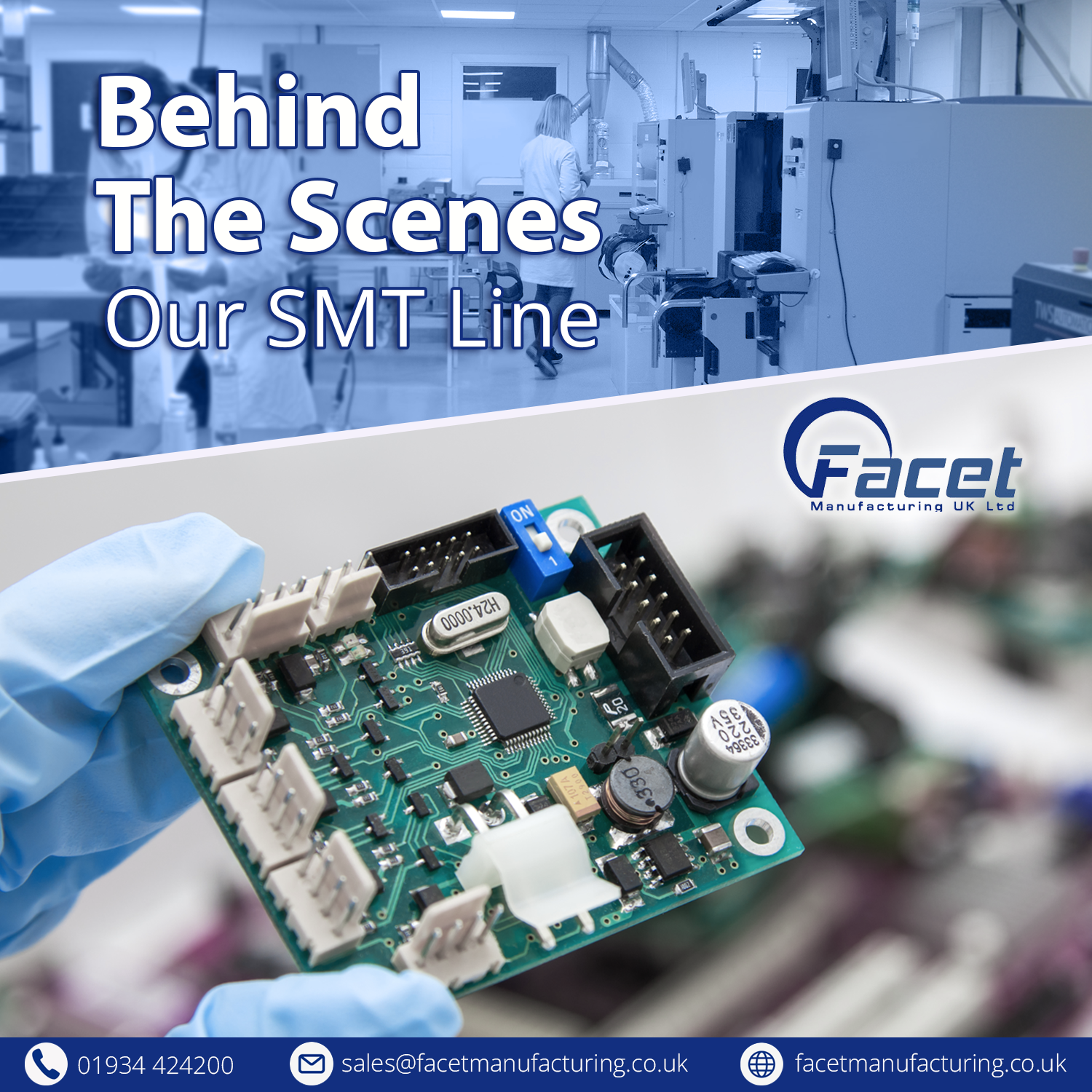
When it comes to PCB assembly, speed and accuracy sit at the centre of every successful build. At Facet Manufacturing, our surface‑mount production line is designed around one priority: consistent, repeatable quality.
Below is a behind‑the‑scenes look at how our SMT process works and the steps we follow to ensure every board leaves our facility built to the highest standard.
Controlled Solder Paste Application
Quality starts at the very first step of the SMT process.
Our automated, vision‑assisted solder paste printing equipment ensures accurate stencil alignment and consistent solder paste application across each PCB. This controlled process helps ensure that every component footprint receives appropriate solder coverage, supporting reliable solder joints and long‑term product reliability.
Solder paste deposits are verified as part of the manufacturing process to identify potential issues such as insufficient paste, bridging, or misalignment before the assemblies move to subsequent stages.
All assemblies are produced and inspected in accordance with IPC‑A‑610 workmanship standards, with capability to support Class 2 and Class 3 requirements where specified.
High‑Speed, High‑Accuracy Component Placement
Our SMT lines utilise high‑performance pick‑and‑place equipment designed to deliver fast, accurate and repeatable component placement.
The machines are capable of placing a wide range of components, including 0201 passives, fine‑pitch ICs, micro‑BGAs, high pin‑count devices, connectors and other complex packages. Vision‑assisted placement supports accurate component alignment and orientation, helping to minimise placement errors and reduce the likelihood of defects and rework later in the manufacturing process.
Reflow Soldering with Controlled Thermal Profiling
Once components have been placed, assemblies pass through a multi‑zone reflow oven where solder joints are formed under controlled thermal conditions.
Defined temperature profiles are used to ensure solder paste is heated, reflowed and cooled in a controlled manner, supporting strong, reliable solder joints across a wide range of PCB designs. Reflow profiles are selected and adjusted as required to account for factors such as board layout, thermal mass and component mix, helping to deliver consistent results across production builds.
Manual Visual Inspection
Before any product leaves our SMT process, assemblies undergo manual visual inspection by trained operators.
This inspection checks for:
Solder joint quality
Component presence and polarity
Tombstoning or component skew
Incorrect or missing parts
Solder bridges, shorts, or insufficient solder
Inspections are carried out in accordance with IPC‑A‑610 workmanship standards, ensuring each assembly meets defined quality and reliability requirements.
By detecting issues at this stage, we ensure problems are corrected before they ever reach the customer.
Traceability and Process Control
Every step of our SMT process is captured and documented.
We maintain full traceability for materials, solder paste batches, component reels, machine programs, and inspection results - giving customers confidence in the integrity of every build.
What Reliable Production Should Look Like
Choosing the right manufacturing partner is about confidence. Our SMT process is engineered to deliver consistency and quality, supporting your project from prototype to volume production.
Contact our team to learn more about our process or discuss your next build. sales@facetmanufacturing.co.uk